Showing posts with label Mediated Learning. Show all posts

Tuesday, September 20, 2011

Survey

Hey Everyone,
In an attempt to make this blog better for you, I've put together a quick survey for you to fill out.
It's 3 questions and can be done in less than 3 minutes.
I'd appreciate your input.

http://www.surveymonkey.com/s/JVH9GHH

Thanks!

Wednesday, March 30, 2011

Mediating Forgiveness

We had a situation come up where it was the perfect opportunity to learn about forgiveness.

After reading Matthew 18:21-25, my daughter said, "I better forgive or I'll go to prison!"
Thus began a mediated discussion on what kind of prison unforgiveness is. To help my babes get the idea of a prison in our heart, I did the following:

First we cut out a picture of someone who needed to forgive.
My daughter cut out Humpty Dumpty. Humpty needs to do some forgiving.
In my craft cupboard, I found the long-forgotten craft grids (or whatever they are called!) that someone gave me once upon a time. They looked a bit like a prison so we placed them over Humpty.
Then we compared how well we can see with the grid in front of our eyes.
The observation was that we can still see things but not very clearly.
Then we kept adding grids in front of our vision. This was the same as remaining in unforgiveness and having our hearts harden with bitterness. They pointed out that it was very difficult to see through the girds.
Much like a bitter and unforgiving heart. We will continue to live life but everything we encounter we won't see precisely or accurately because unforgiveness colors our perception.
Look at Humpty! He can't be seen for all the unforgiveness and bitterness.
We discuss about why it's important to forgive and to walk in love.
We decide that we want to be people who forgive.
and Humpty does too!

Sunday, November 7, 2010

Structural Cognitive Modifiability

Structural Cognitive Modifiability, which will now be known as SGM on this post and blog, used in a Mediational context needs to be thought of as a type of scaffolding erected to help make structural change.
The scaffolding is meant to be temporary and removed when the individual becomes an independent learner.

STRUCTURAL-involves organization and integration of the components that make up our thinking.

COGNITIVE- rekates to the ability to think.Cognition means how we think.

MODIFIABILITY- means having the ability to adapt to alter and to regulate.

Let them eat cake...or whatever they want!

Hey Everyone,
If you haven't given your two cents worth on what ML workshop you want next, NOW is the time!!!
Wisdom Chat Boards (found here) has a request for your input.

Here's the scoop:

Please share in numerical order which of the following workshops interest you most (in order of preference, first to last choice).

1. Mediated Learning for the gifted child.
2. Mediated Learning for the pre-primary and primary aged child (little ones).
3. Mediated Learning for marriage.
4. Mediated Learning and the High School aged child (which would include HS students attending workshop).
5. Mediated Learning and the math challenged child.

Rate them in the order interest.

Go,go,go,go,go,go!

Don't Be a....But

Here's something that was mentioned at a Mediated Learning Workshop:

Refrain from using the cliche statements of, "This is a wonderful story, but..." or "you did a great job making your bed, but...."

When it was mentioned I thought to myself, "I don't need to worry about that. I don't use the word 'but.' I know better."

Or maybe not.

I've caught myself ready to say "but..." to a great many of things the past few weeks.

Using the word "but" after a compliment is the equivalent of saying, "Forget what I just said before because now I'm going to point out your flaws."

So, tell me, how can you bring correction or direction to a task without using the word "but"?

Friday, September 10, 2010

New year, new start?

It’s a new school year.


You have a binder full of mediated learning notes that have collected dust over the summer. Deep in the annals of your memory you remember something about the brain being modifiable and able to change. You are thinking this is exactly what needs to happen with my homeschool--a lobotomy!


But where do you start when you’ve kinda forgotten everything you learned at a workshop last January?


Well, let me ask you something.

Where do you think you should start?


Take a moment and assess yourself and where you are at with homeschooling this week. Are you just struggling to get back into routine? Pulling your hair out at the resistance to a subject exhibited by a child?

Where is your current weakness?


I’d like to suggest that you bring out your mediated tools and start there.


Sit down and ask yourself some questions:

What isn’t working?

Why isn’t it working? Is it me and my expectations? Are the kids repeatedly missing my point when I say, ie. “Clean up the room?”


Find the trigger point of conflict. Then ask yourself, “What needs to be done here?”

and “Does my child truly, and cognitively, understand what I am asking of them and how I am expecting this to be done?”


If they don’t, how can you teach them to understand what’s expected? What questions can you ask them? How can you bridge this situation to future learning or past successes? Where will this skill/opportunity be useful in the future? Why is it important to you? Why do you want this to be something they value? How can you communicate it’s importance in an effective way?


Beware of thinking that says, “I don’t have time for a binder full of notes from my last workshop! I have laundry to conquer.”

Your binder and all it’s notes are there as handy guides. Use them to help you.

But for the moment, forget the notes and go back to the simplest form of Mediated Learning:


Asking questions.


Ask questions and find a way to incorporate the 3 components of Mediated Learning:Bridging, Infuse with Meaning, and Intentionality.


You can do it.

Wednesday, August 11, 2010

Mediating Math pays off

Remember my math nightmare last year with my eldest?
I call it a math nightmare, but only to be dramatic. It wasn't a nightmare, just a wake up call for how I was going about teaching math.

We were frustrated, angry and annoyed over working on math. Too many times, we would both walk away from her workbook shaking our heads and muttering under our breath.

And then I took my first Mediated Learning course.

I came home and put the work book away. I went online and ordered books from my library on math games, famous mathemiticians and brought out dice, cards and Blokus. For the next three months, all we did was play math games.

Why?

Because the LOVE of learning needed to be restored.

Why?

Because learning math isn't just about adding digits together. Learning math helps our logic and problem solving skills. We need these skills to face life.

And while we played games, I mediated our math.
How does this compare to that?
Why do you think the answer is always the same?
How can adding help us at the grocery store?
When does rounding up help us when were at the lumber yard?

We worked and played and had loads of fun with math.

During the summer, I was cleaning out the garage and came across a new math book. It was the one we were supposed to do this year, but never got to because we were to frustrated to finish the first one.

Well, guess what?

My daughter found it and said, "Hey, can I try this?"
I nodded and sighed inwardly. I wasn't sure workbooks were something we were willing to look at again.

Well, guess who got the shock of her life?

Me!

My daughter sat down and worked on 21 pages and taught herself two new concepts.

Yep.

It's not about producing 21 pages of work. That's not what got me excited. What got me excited was when I said, "Wow! Twenty one pages. How come so many?"

A bright smile appeared on her face. "Because I love math."

Friday, June 4, 2010

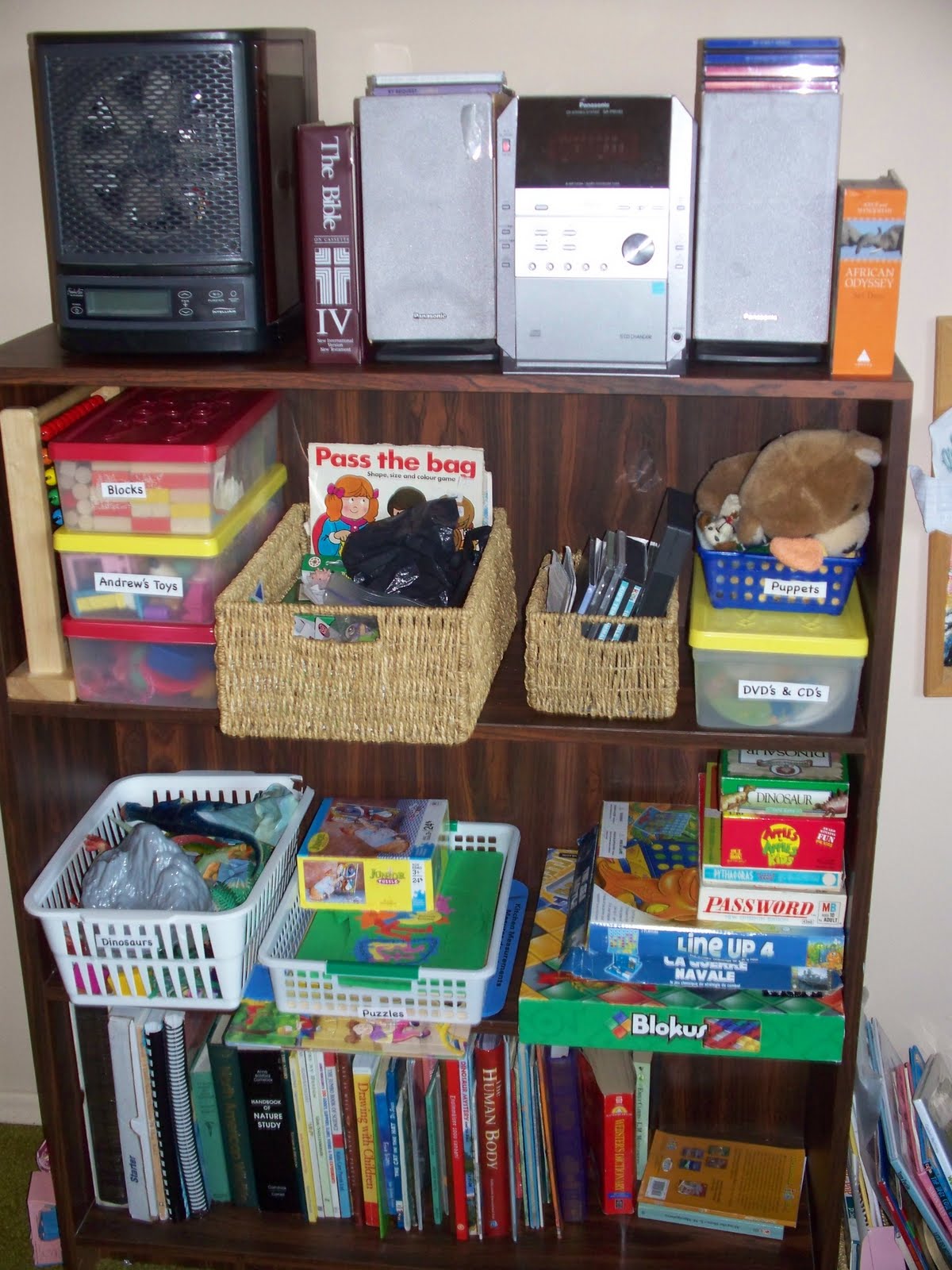
Picture Perfect!


Isn't that a beautiful bookshelf?
I thought so.
And here's how this photo is going to bring joy to my household.

It's a mediated Learning idea.

Step 1: Tidy your bookshelf
Step 2: Take a picture and PRINT it off
Step 3: Have your children refer to this page whenever they tidy up
Step 4: Mediate

But how do I mediate?
Elementary, Watson!

Take a look at this picture, is there anything different between this picture and the bookshelf?
The puzzle on the floor, where does it belong according to this picture?

Keep the picture in the room and when you have them tidy up, ask them if the shelf is tidy the way it is in the picture.

Wednesday, May 26, 2010

Schedule changes? Mediation to the Rescue

So, summer is approaching and that means a change in scheduling for us.
Not really anything big, just little things.

But sometimes as a mom of little kids I can forget that I can't keep our schedule all to myself.
It's REALLY important thatI communicate to my kids that they know what to do each day.
Because if they don't...
it's "Mom, I'm hungry. Mom, she touched me. Mom, there's nothing to do."

That drives me up the wall, around the bend and off to zone-out land.
So, to combat that, I need to have a scheduled routine that let's my kids know what they should be doing and when they should do it.

(Insert a song and dance for Teri Maxwell, creator of Managers of Their Home. I love you, Teri! You are a genius!)

Because there's no greater pleasure for a mom then pointing to the schedule board when they say, "I'm hungry." (Fruit bowl on the table or wait until designated snack time. 10 points for mom for not losing her cool!)

or..."there's nothing to do" is met with a quick journey to the schedule to see that, oh yes, it's reading quietly time (25 points for mom for not rolling her eyes and saying "Oh please!"!)

...and my kids fight less when they have something to do...otherwise, they get bored and hit each other. (Note to self: find ways to cultivate creativity that don't involve bodily harm)

So, all of that above spiel is to lead up to this tiny little blog post point:

*When you need to make adjustments to your schedules, mediate them!

How do we do that?

Oh, you'll have to come back later this week when I reveal more mysteries of the deep.
Muahhahahahaha!


**I may or may not be writing on a full night's sleep

Tuesday, April 27, 2010

Change: Not just loose coins in your pocket

We've taken to eating differently.

We're almost raw foodists.
It's easier to say that then sugar-free, gluten-free, meat free except for farm fresh eggs and the occasional salmon and dairy free except for organic butter (because I will not give up butter, no, no I will not)

Anyway, it's brought a lot of interesting discussion.
Mainly a resistance to change.

Can you bring your family to a place of change concerning food? You betcha!
here's how

Define the Problem (Intentionality and Reciprocity)
Do we like having these particular health issues? What do we need to do to solve them? How can nutrition change or help our bodies?

Long-Term Options (Bridging)
What do you think happens when you don't feed your body good things? What does the Bible say about our health? Do you think we can glorify God with our food habits?

Pay-OFF (Infuse Meaning)
How is it going to feel when our bodies are cleansed and we've got all these detox nasty things out of our bodies? How do you think we'll sleep? Do you think we'll be grouchy?


One thing we have taken the time to do, is to find out what is in the food we eat and what part of the body it effects.
For example, we drank some vegetable juice with parsley in it. We talked about how parsley cleanses our kidneys and helps them function like they are supposed to. Then we talk about how the kidney has been made to recognize what is good and only let in what is good for this organ. It is constantly bombarded with things that aren't meant for it but rather than having to identify what is bad and shouldn't let in, it focuses on what is good and only looks for the good things to take in.
How does that relate to our relationship with God and living holy? Do we have a long list of things we need to say no to or do we familiarize ourselves with all the things He loves so that we can immediately focus our hearts on what is good for us?

Changing taste buds, changing hearts can all be done by using mediated learning and some carrot juice.

Wednesday, March 17, 2010

5 Reasons Why You Won't Try Mediated Learning...But You Need To

When I first heard about Mediated Learning from my facilitator, I thought, "That's nice, Louis."

First of all, it sounded ambiguous.
Second, I was new to homeschooling. I was still trying to crystallize our reasons for homeschooling thatI didn't give much thought to taking on something new.
And thirdly, it sounded ambiguous. I know that's number one, but I don't always catch on very quick.

But once I started talking to Joyce and Louis (our facilitators) I realized that there was more to Mediated Learning. Let's take a look at some reasons and see if we can't find a way to make Mediated Learning work for you.

5 Reasons Why You Won't Try Mediated Learning....But You Need to

1. Ambiguous, Cryptic and Other Words Authors Use to Describe the Word Vague
Sometimes I have had a hard time nailing down a clear definition of Mediated Learning. When I first started sharing it with others I would use the core to try to explain...and then I would stumble on my words and try and give a relevant example. And then I would be quiet because I could tell people weren't getting it and I wasn't explaining it well.

Here's what it boils down to: Mediated Learning is about...drumroll...teaching your child to think and to examine their thinking skills so that they can change, adapt and learn in any situation.

2.Been There, Done That, Own-the-oodles-of-curriculum-that-I-bought-at-50%-off-but-have-never-used to prove it
Perhaps Mediated Learning looks like one more gimmick. An elusive promise that says you will be more organized, your house will be cleaner, your kids will listen better, you won't ever fight about math again and you will be able to make them the most well-mannered, thoughtful and God-fearing kids in the world.
Um....well.
All of that is possible. But it's going to take time.
It's going to take some time to learn how to incorporate this approach to enhance your child's learning. It's going to take some time to reflect so that you can recognize what is a spiritual issue, a character issue or a cognitive issue. But guess what? Mediated Learning can help in all those areas!

3. “The only reason for time is so that everything doesn't happen at once.” -Albert Einstein
If you thought about saying, "I don't have the time to learn this" then you aren't alone. I thought so, too.
But then I gave it some thought. Anything that has VALUE to me, I make time for....
Wait, did I just say anything of value??? Isn't that a Mediated Learning principle? To infuse value and meaning into what my child is learning so that it has greater significance to them?
I think so!
If my children understand the meaning and value behind math, will they be more likely to use it?
I think so!
If I can see the value in teaching my children meaning in their learning, can I take the time to learn how to do this?
I think so!

4.There's a method to my madness, and I can only take so much madness
You're saying, "I have a method of teaching my kids (CM,unschooling,Classical, etc). We're happy with it. We're in a rhythm and I'm not changing horses mid-stream."
First of all, can I just say something: Who changes horses mid-stream? Obviously, this statement came about because someone once tried it, but seriously, who does that? Probably some city slicker all wet behind the ears. I don't expect you to be one of those!
Second of all and back on track to the matter at hand, you don't have to stop doing what you are doing in your home. If it's working for you, great! Consider this the sprinkles on the ice cream, the syrup on the pancakes, the cheese on the pasta...you get the idea!
Just add this in to what you are currently doing and enhance your daily learning.

5. Why haven't you started yet?
Possible answers:
b)How do I get started? At the beginning, of course!
c) There is no one to babysit my kids when the course is going on.
OK, very valid reason.
The questions I have for you are: do you get a babysitter when you want some quality alone time with your spouse?
Do you get a babysitter for when you need some time away for yourself?
Do professional teachers have days where they learn a course and update their skills?
Can you arrange for the kids to be babysat at the event?
Where there's a will, there's a way.
It's not, "It can't be done!" The question is, "How can it be done?"
Wait, did I just employ a Mediated Learning method used for problem solving?
I think so!

There you have it.
5 reasons why you won't try mediated learning...but you need to.
Just try it!

Tuesday, March 16, 2010

Where do I begin? May I suggest that you start at the beginning

If this is your first stop at my blog or your first look at Mediated Learning, you might be overwhelmed.

You might be having feelings similar to myself when I first looked at the Charlotte Mason method. I thought "I have no idea if this is doable. The outdoor bit sounds nice, but I don't want to read six volumes on homeschooling or run around using the word twaddle."
Lo and behold, I was in for a shock when I realized that the CM method, as it's common moniker has become, was extremely simple and doable. All it took was taking things one step at a time.
And while I don't exclusively use the CM method for teaching (I'm kind of like an eclectic/on-the-verge unschooler--which really means I'm still figuring it all out), I use many of the principles in her ideals about learning.

And I sometimes use the word twaddle.

So, let's get back to talking about ML and break it down.
Let's call it Mediated Learning 101.
How do I start? What do I do?
Do I start with cognitive functions?
Do I have to carry a dictionary in my purse at all times?
What is the difference between the core and criteria?
Are you going to make me use the word twaddle?
All valid questions.

Before I answer any of these questions, let me just clarify that I am not an expert in Mediated Learning (which henceforth will be known as ML). I am a parent who wants to be diligent to do all that the Lord puts in front of me to do. And right now, this is it.
So with my vast amount of expertise and many letters after my name (5 minute mom, phd in abc) let's go forward...

ML 101

Q.How do I start using Mediated Learning in my Home?
A. My question to you is, how can you incorporate asking questions instead of giving answers? Do you think you can, instead of giving a ready answer to your child's inquiry, ask a question to see if they can find the answer out?
When your child says, 'why does this happen', are you able to first ask, 'why do you think it happens'?
What is the difference between telling your child the answer rather than seeing what they already know about an answer?
Do you think you can expand their answer further by asking more questions?
To summarize: Ask,ask,ask questions
Read here about fostering time to focus on this new habit.

That's it. That's how you start. That's the whole 101 part.

Naturally, there's 101 part a,b,c and we'll get to those.
But let's face it...an elephant is easiest to eat when done one bite at a time.

Which brings up some important questions: Who eats an elephant? When they do eat an elephant, are they eating the tough skin? Do they eat elephant wrinkles? How long does it take to eat an elephant? Just how big is this metaphorical elephant anyway?


Which one are you: A Mediated Learning Parent or Insane?

A great way to help our children develop thinking skills and model problem solving skills is to talk out loud while you do activities.
Now, since talking to yourself is a sign that shows your insane let me clarify what I am saying.
What I am saying is that you need to talk to yourself....
and your kids.
Basically, you need to model your thought processes for your children. This helps them understand how to tackle a problem, the various solutions you come up with to these problems and the different activities involved in the execution of those solutions.

To illustrate my point, here is a real-life scenario from my house.
Not far-fetched at all. ;)


The kids are colouring at the table and I am cleaning the counters.
Mom: "Ok, so I'm just going to clean up this counter and wipe it down so that it's clean. I want to put everything that's on the counter back where it belongs so that later when we make dinner, we can do it easily without having to be frustrated with a mess on the counter."
Eldest: "Mom, who are you talking to?"
Mom: "You guys...and myself. I'm trying to tell you about how I clean off the counters so that one day you, too, can clean off the counters!"
Eldest: "You aren't trying to give me another chore are you?"
Mom: "Just go back to you colouring."
Colouring and cleaning resumes.
Mom: "First, I see our plants need some water. 'Hey Polka (that's our polka dot plant), looks like you are needing some water today. Let's give you a little bit of love.' I'm going to give Polka some water and take off some dead leaves so that she's healthy. I'll put her back on top of the counter now and position her differently so that she gets some sun. 'Is that better, polka? I thought so.' "
Four year old: Mom, why are you talking to the plants?
Mom: How's that colouring coming?
Colouring and cleaning resumes.
Mom: I'm going to put these art supplies in the art closet. Actually, come here, you guys can put this back in the art closet. I asked you to do that earlier. Here, take this."
Kids put art stuff away.
Mom: Thanks girls. Now I'm going to take this box off the counter because it's blocking the window and...GET OUT OF MY YARD! "
I open the window and yell at the neighbour's cat who is trying once again to forage through my garbage.
Mom:"GIT! Yes, I'm talking to you, cat. Out of my yard!"
I shut the window with force which makes enough noise to scare the cat away.
Girls: Was that Pluto again?
Mom: "Yes, but don't worry about it. He's gone now. What was I doing? Oh right, modeling for you. ( A momentary thought on how yelling at the neighbour's cat might not be something I should be modeling). I spot a sock on the counter, "How did you get here? You aren't supposed to be up here. You should be in the laundry room! You know, I don't understand how it is that you can be here."
I put my hand into the sock and make it respond.
Sock:"Well, you see, I've gone travelling. I was supposed to be in the laundry room but I decided to stop here."
Mom:"Oh really?" Why was that?"
Sock:"Because one of the girls put me here. It seems that they got distracted from their chore and decided to put me here for awhile."
Girls: Mommy! You are being silly!
Sock: No, I think it was silly that you forgot to bring me all the way to the washing machine.
Mom: Would you like to go there now, Mr. Sock?
Sock: Yes. Yes, I would.
Mom: Who wants to help Mr. Sock go home?
Girls: I do! I will!
The sock is returned to it's rightful place and I finish up.
Mom: So now, I'm going to wipe down the counter and get rid of any germs that would be left on the counter.
I silently tell myself that I need to make more homemade cleaners. Which then leads to the need to put baking soda on my grocery list. Which then leads to the need to make time to meal plan today so that I can go grocery shopping tonight. Which then leads to the struggle of grocery shopping vs. blogging that I hoped to do and spend time with my husband and call my Mom and soak flax seed for the morning and call cousin Darla for a recipe and write a birthday card for someone and, and, and.....ahhhhh! ENOUGH! I say to all the voices in my head.

Wait...voices in my head.?
Is not that the sign of insanity?
Have I just lived through questions 1-10 in the Insanity Test?
All from trying to be a good Mediating Parent who role models thinking strategies?
AHHHHHHHH!

Thursday, March 4, 2010

10 Steps to a Mediated Moment

One of things I adore about Mediated Learning is how empowered you feel in the area of connection and communication with your child or spouse. (Oh yeah, ML is for your marriage too!)
As I've gone through labelling my blog, I've realized that there is no basic "How To" for having a mediated moment.
Perhaps this can paint a picture for you. ( I will use on the Core in this example)

First we need an area that needs mediating. This can be a conflict, a problem or a new situation that requires learning new skills for your child. Here's how to make a Mediated Moment:

1. Identify the problem. You and your child keep butting heads but what is the real reason? Is it their attitude? Your attitude? Do they feel incompetent? Are they afraid of trying something new and acting out at you? Ask yourself some questions to identify the problem and pray asking God to give you insight.

2.Strategize. Once you identify the problem, take a moment to gather some memories of past successes in an area of challenge. Make a note of some of the expressions or behaviours that happen whenever this problem comes up. Find a scripture to encourage your child. Basically, use this time to prepare yourself for HOW you want to achieve breakthrough with your child and have some examples handy.

3.Set the stage. If you are new to this, tell your child you are going to use some mediational tools to help overcome the challenge in this area and that your goal is to walk away with them in unity and to resolve this problem together. (You are already engaging in intentionality in this step) A simple statement such as, "I've noticed that we keep running into hurdles in math and I'd like to talk to you about how we can overcome them together." Confirm to them that you are working with them.

4.Play with a full team. Make sure your child is in agreement with you. This is reciprocity.They need to be engaged and looking at you.

5.Make it Meaningful. When taking on a problem, you need to help your child see WHY this needs to change. Infuse it with meaning so they can see the significance in what they are doing. We naturally answer these questions when our children ask, "Why am I doing this?" "What is this good for?" Bringing reason behind WHY will help your child understand what they need to do in order to learn or change.

6. Be Like a Bridge over Troubled Water . Bridging is when you make connections between current learning and previous experiences. These connections are often made by referencing life in the home, the community and the world. You may find yourself saying something like, "Do you remember when you completed that task that was difficult last week (month or year ago--connecting them with past successes)?" or " Where do you think this skill would come in handy in working on a team?"(painting a picture of future need of this skill) or "How do you think this skill will help you when you are older and living on your own?"

7. Ask and Be Quiet. If you still are unsure about what to do in a mediated situation, ask questions. And then be quiet and listen. You can learn so much from your child just by asking questions with a sincere desire to find out how they are handling this situation. Some great open ended questions to get you started are, "What do you mean by...?" "Can you explain further?" "How do you feel when...?"

8. That Lovin' Feeling. After you've talked with your child you should both leave knowing that you have been heard and understood. It won't always be a hallmark moment feeling especially if you have teenagers who grunt, but it should feel as though progress was made and a breakthrough occurred and there is now an understanding, if not a desire to attempt to learn or change.

9. Go Back . Upon reflection, if you realize that you missed out on bringing a good sense of Meaning to the discussion or any other element, go back and say, "You know, I was thinking about what we were talking about earlier and I realized that..." There is no shame in going back to square one and saying, "I'd like to tackle this again." Remember, you are learning too.

10. Celebrate.When you and your child conquer the challenge to learn or master something that was difficult, celebrate. High fives, special tea, pat on the back, words of praise, etc. are important. Together you have worked hard to achieve it and you need to set a habit of celebrating the accomplishment of great things. After all, you always want to leave your child in the place of success.


Saturday, February 13, 2010

Me, Disorganized? Inconceivable!

I have been having a Mediated Learning weekend in review!

I have needed to go through all of my papers and organize them. And I've had tons of ideas coming at me at once, so it was time to have a little mediated talk with myself:

"Self, why is it important to be organized?"
"So you can find what you are looking for when you need it."
"And how do you think that helps your family?"
"Eliminates stress and unnecessary whining from me that I never have time to gather my thoughts."
"Yes, exactly. How do you think your family will feel in the future knowing there is calm and orderliness where your paperwork is concerned?"
"Everyone will breath a sigh of relief and feel calm and orderly."
"Exactly."
"In my defense, I haven't had a lot of spare time."
"In the words of Vezzini in The Princess Bride,'I do not accept excuses. I will just need to get myself another giant."
"Huh? Wha-?"
"Oh, nevermind."

So after that little talk with myself I went through my papers and sorted them according to my liking and put them here:
In my binder book which I cleverly entitled: Mediated Learning.
Then I wrote out the Mediation Core and Criteria.

Yes, that's right, I wrote it out. Our printer is on the fritz and rather than way lay this project one more time I decided to handwrite out the most important parts to me.
And that turned out to be very good because I immersed myself once again into all the great information I've gathered over a course of two workshops. It also helped me crystallize my thinking on why I am writing this all out and taking the time to stick it onto the door.
It also allowed me to pick two or three areas to hone in on this week, as well as write up all the questions I want to ask my children to kick start thinking.
John, a workshop presenter, mentioned writing up the various questions and sticking them on a key chain for quick reference. Here are mine before they go to the laminators.


And then I breathed a sigh of relief. Because I was organized and ready to sit down with my hubby and talk to our kids about using mediated learning in our home and what that is going to look like.
It was a day that made me feel good and accomplished.

"Self, how do you think this will affect your organizing skills in the future?"
"Well, I realize that if I make time for what's important and put things in place right away, I won't feel overwhelmed by wanting to do something but not feeling prepared to do it."
"Exactly. You don't want to fall prey to classic blunders. As Vizzini said in the Princess Bride, 'You fell victim to one of the classic blunders - The most famous of which is "never get involved in a land war in Asia" - but only slightly less well-known is this: "Never go against a Sicilian when death is on the line"! "
"Huh? Wh-?"
"Oh, nevermind."

Thursday, January 28, 2010

Getting the Family on Board Pt. 1

OK, so you have just come back from one of the most fascinating workshops you've been to in your homeschooling life. (Yes, it was even better than the event where they gave away free curriculum)
You've learned about Mediated Learning, you see the potential and you are now a gigantic hose of raw power ready to fire hose the smallest of fires that would quench your vision of grandeur for mediated success.
Slow down, hero. Put the brakes on and rein yourself in. First, we gotta get the family on board.


DOWN ON THE HOMEFRONT
I thought for a while and decided the best way to go about this is the Mediated way, of course! (You know, I should get a nickel for every time I put the word 'mediated' into this blog post, because I feel that it could be a real money-maker for me).
First step should be to get your spouse on board, if they aren't already.

Intentionality and Reciprocity: To listen and hear what my spouse thinks about Mediated Learning by helping him/her understand the impact of using this method of learning.
Meaning: Emphasize our values and show how this will help us live them out.
Bridging: Paint word pictures of how things can look in the future with the use of mediated learning using examples of other families success stories. Highlight areas of contention that we have been trying to solve within our family and show how this could bring about change.
Also, highlighting the correlation between the role mediated learning can play with instruction in righteousness for our children's character.

I will provide a few ideas down below, but first maybe you can relate to my story.
Maybe you can relate.

AND...ACTION!
I came home from our workshop over-the-moon excited about Mediated Learning and talked for a mile a minute for half an hour before taking a breath. I poured forth like the dam being released, except nothing was related to each other. Just a lot of random snippets that were tossed out only to be interrupted by me saying, "Oh yeah, and then there was this one lady who shared...". It had all the earmarks of a gong show.
You might be thinking, "The excitement and fervor clued your husband in on how important this is to you."
Um...no. Not because he isn't astute. He is very astute. And he knows me soooo well.
I tend to get excited about the 'new thing' all the time.
My first year of homeschooling I went from the schooling approach of unit study-to classical- to unschooling-to Charlotte Mason-to unit study and back again. He knows what I'm like when I read a book or attend a seminar.
So, I had to approach things differently to first let him know I was serious about it.

Naturally, I got on my knees and prayed. And I got an idea. More importantly, I was able to realize what the most important priority of our discussion would be. My main motive here is not to make him see that mediated learning is the way we should be doing things. My main motive is to listen to what he thinks about it and if we, with God's leading, feel it is the way He would have us learn in our home.

And that, my friends, is key.

Some of you may have your spouses on board before you attended the workshop. For those who didn't, here are some questions to help you to make the connection (oh, I'm not giving you an answer! We're doing this the mediated way):

When could you take time to ask God for an idea?
When is the best time to get your spouse's full attention?
What creative way could you use to make a date to talk about this?
How could you turn this into a memorable moment for each other? (something that makes you look back and say, 'I remember where we were sitting when we made the decision to try this')
What distractions do I need to get rid of for us to have a meaningful discussion?
How will I remind myself to just listen without interrupting?
What are the most valuable things that I want to communicate in fifteen minutes about this approach of learning?
What examples can I use to bridge to the past?
What examples of his success or our success in making decisions together can I pull from?


Do you have any questions to add to this list? Leave a comment and let the thinking begin!